
Overview: Deliver predictable aesthetic restorations in three visits using Dandy’s digital workflow from consultation to final seating.
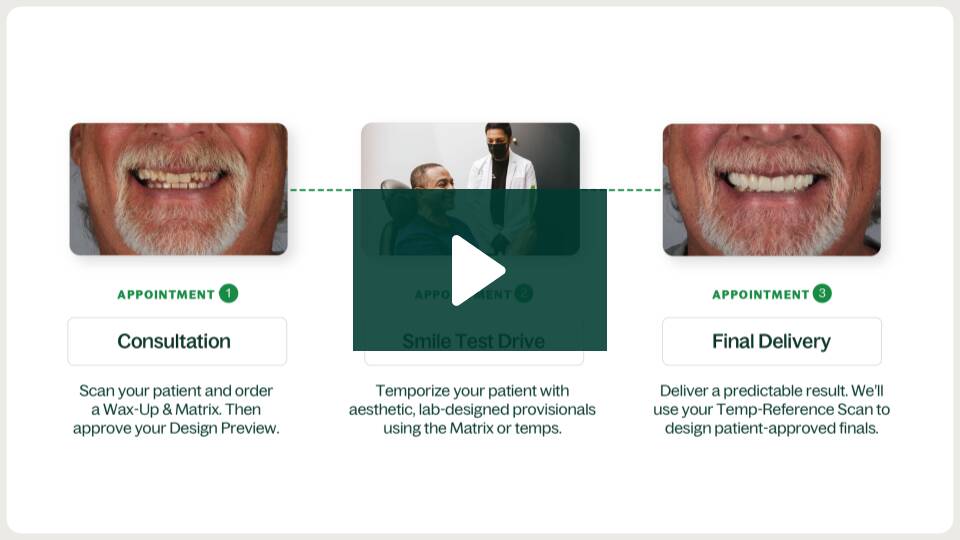
Tutorial: 3-Appointment Smile Makeover
Conduct the Consultation Appointment
During the first appointment, the clinician scans the patient, captures clinical photographs, and orders a Physical Wax-Up and Matrix.
Start the Order: Enter the patient’s name in Chairside and select Wax-Ups & Matrix from the main menu.
Select Products: Choose Physical Wax-Up & Matrix and select the specific teeth for restoration.
Choose Matrix Material: Select the preferred matrix material for the temporary restoration.
Upload Patient Photos: Scan the QR code with a mobile device to upload files. These photos allow Dandy lab technicians to design restorations unique to the patient.
Perform Intraoral Scans: Complete the Upper, Lower, and Bite scans as prompted by the software.
Add Design Preview (Recommended): Request a digital design for approval before 3D printing. Clinicians receive notification via email or text when the design is ready in the Dandy Portal.
Select Smile Style: Choose the specific aesthetic style for the digital design.
Execute the Smile Test Drive Appointment
The second appointment involves temporizing the patient using the lab-designed Matrix, capturing a Temp-Reference Scan, and ordering the final restorations.
Continue the Treatment: Enter the patient’s name in Chairside. The system will prompt the user to order the final restoration based on the previous wax-up data.
Select Final Materials: Choose the fixed restoration type (Crown, Bridge, or Veneers) and the preferred restorative materials.
Prepare and Rescan: Prepare the dentition. Rescan the preparations, ensuring the margins are clear and fully visible for the lab.
Seat Provisionals: Fill the Matrix with provisional material and seat it over the prepared teeth. Maintain steady pressure during polymerization. Remove the Matrix and adjust the temporaries as needed.
Capture Temp-Reference Scan: Scan the seated temporaries. Dandy technicians use the Temp-Reference Scan to ensure the final restorations match the approved form and function.
-
Define Final Design Logic:
Reference seated temporary scan: Replicates the aesthetics and function of the current temporaries.
Replicate wax-up exactly: Follows the original 3D-printed design.
Replicate wax-up with adjustments: Allows the clinician to annotate changes on the digital model.
Deliver the Final Restorations
In the third appointment, the clinician removes the temporaries and seats the final restorations. Because the restorations were designed using the Temp-Reference Scan, they should provide a predictable fit that requires minimal adjustment.
Instructions for Use
- Global IFU - Bridge (Polymer)
- Global IFU - Bridge (Metal - Ceramic)
- Global IFU - Bridge (Ceramic)
- Global IFU - Crown (Polymer)
- Global IFU - Crown (Metal)
- Global IFU - Crown (Metal-Ceramic)
- Global IFU - Crown (Ceramic)
- Global IFU - Inlay - Metal
- Global IFU - Inlay - Ceramic
- Global IFU - Veneer